The Compression Con: Why Your Expensive ‘Tour’ Golf Ball is Ruining Your Score (And Wallet)
Walk up to the first tee box of any local muni, and you’ll see the exact same ritual. A golfer pulls a brand-new, premium, Tour-level golf ball out of a sleeve that cost them nearly $60 a dozen. They tee it up, check their high-tech GPS watch—hoping they aren’t violating the latest USGA rules on artificial advice—and promptly slice it 40 yards into the deep jungle.
There goes $5. Gone in five seconds.
But losing money isn’t even the worst part of this equation. The real tragedy? That premium, high-compression Tour ball they just lost was actually making their slice worse and their distance shorter.
Welcome to the Compression Con. For years, major golf manufacturers have successfully convinced the average amateur that to play like a pro, you need to play the ball the pros use. In 2026, with premium ball prices hitting all-time highs, continuing to fall for this marketing trap isn’t just an ego check—it is active sabotage of both your scorecard and your wallet.
The Hard Physics: What is “Compression”?
To understand why expensive balls hurt the average game, we have to look at the physics of the strike. When your clubface impacts a golf ball, the ball doesn’t just bounce off; it temporarily deforms, squishing flat against the face before violently rebounding. This “squish” is how energy is transferred from your swing into the ball.
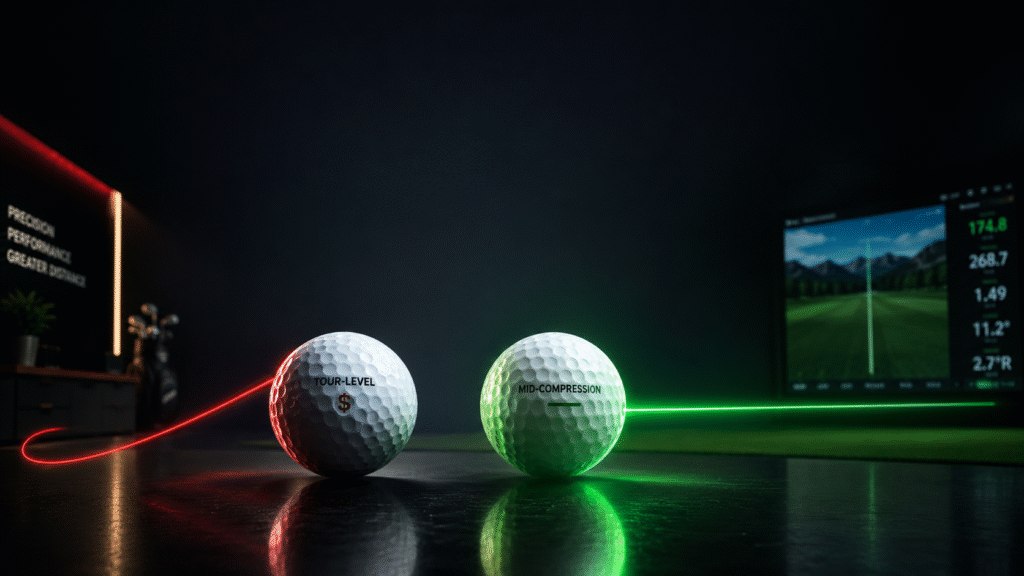
- High-Compression Balls (Tour Level): These balls are stiff. They require immense clubhead speed—typically 105 mph or higher—to fully compress and activate the core.
- Low-to-Mid Compression Balls (Value Level): These are softer. They are engineered to compress fully under average, mortal swing speeds (85 to 95 mph).
If your swing speed is average and you hit a stiff Tour ball, you fail to compress it. It feels like hitting a rock, it spins excessively offline, and you leave significant distance on the fairway.
The Golden Rule of Value Golf: If you cannot swing like a pro, do not play a ball that requires you to. You are paying a premium price for a performance feature you physically cannot unlock.
The Side-Spin Tax: Slicing Your Money Away
Tour balls are intentionally designed to spin. Elite players want high spin off their wedges to stop the ball on hard, fast greens.
However, a core principle of ball design is that spin is three-dimensional. If your swing mechanics tend to produce an out-to-in path (the classic amateur slice), a high-spin Tour ball will grip the air and exaggerate that lateral curve.
When you switch to a budget-friendly, mid-compression, low-spin ball, two things happen immediately:
- The ball compresses fully, giving you an optimal energy rebound (more distance).
- The reduced spin axis keeps your mishits closer to the target line, turning a catastrophic reload into a manageable shot from the light rough.
The 2026 Budget Ball Leaderboard (Sub-$35/Dozen)
You don’t need to empty your wallet to find a ball that fits your swing speed. If you are looking to build a highly effective, cost-conscious setup—much like sourcing components for a custom under-S$700 “Franken-Bag”—these are the top value performers on launch monitors today:
1. Maxfli Tour / Tour X
- The Vibe: The ultimate direct-to-consumer challenger.
- Why it wins: It features a genuine urethane cover (the material used on $60 tour balls) but is regularly on sale for under $35 a dozen if you buy in bulk. It gives you premium greenside feel without the luxury tax.
- Best for: The single-digit or low-teen handicapper who refuses to overpay.
2. Srixon Q-Star Tour
- The Vibe: The sweet spot of compression.
- Why it wins: Srixon specifically engineered this ball for moderate swing speeds. It provides a soft feel, excellent distance off the tee, and enough urethane spin around the greens to satisfy your short game.
- Best for: Mid-handicappers swinging between 85–95 mph.
3. Bridgestone e6
- The Vibe: The ultimate straight-line weapon.
- Why it wins: It is a low-compression, two-piece construction designed entirely to minimize side-spin and maximize distance. It feels incredibly soft and is highly budget-friendly.
- Best for: High-handicappers fighting a severe slice.
The Cost-Per-Round Math
Let’s look at the financial reality. The average mid-handicapper loses roughly 3 to 4 balls per round.
- The Ego Route: 4 Tour balls at $5.00 each = $20.00 lost per round.
- The Budget-Smart Route: 4 Optimized value balls at $2.20 each = $8.80 lost per round.
Over a standard 25-round season, that minor adjustment saves you nearly $280. That is more than enough saved capital to completely fund a weekend getaway, playing through the dramatic limestone tracks highlighted in our Ipoh Golf Guide.
Drop the Ego, Save Your Cash
The next time you walk into a pro shop or check out equipment online, ignore the marketing banners featuring tour professionals. They are playing a completely different sport than the rest of us.
Drop your ball compression, lower your side-spin, and keep your hard-earned money in your pocket. Your scorecard—and your wallet—will thank you.