The GHIN Illusion: Why 80% of Golf Handicaps Are Pure Fiction
The Controversy:
Golfers take their handicap index incredibly seriously—it’s the ultimate badge of honor. By calling out the rampant manipulation of the system, you will trigger both the “vanity handicappers” (who cheat to look better) and the “sandbaggers” (who cheat to win net tournament money).
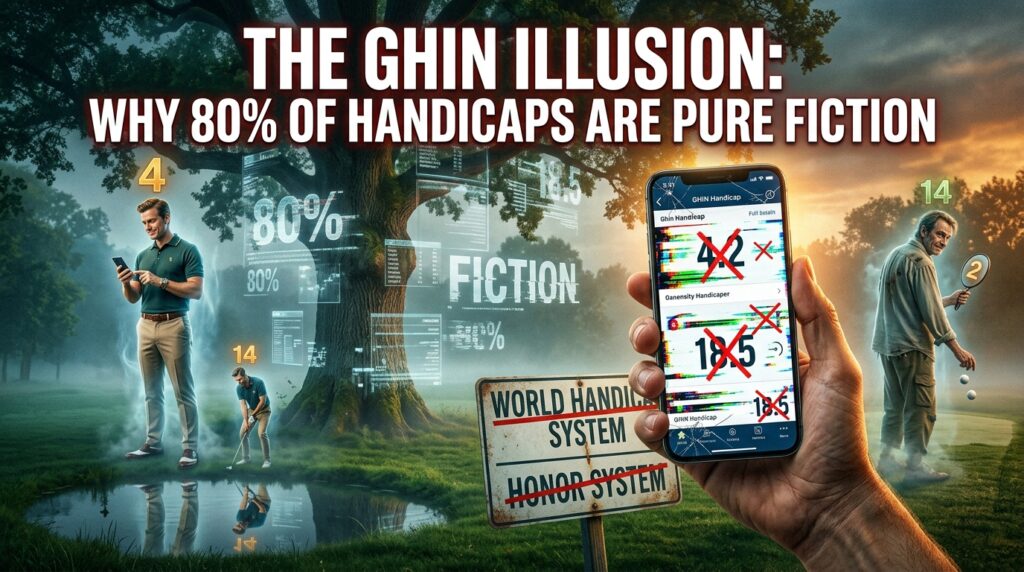
The GHIN Illusion: Why 80% of Golf Handicaps Are Pure Fiction
Golf has a truth problem, and it lives inside your smartphone.
The World Handicap System (WHS) and the GHIN app were designed to be the ultimate equalizers—a beautiful, mathematical way to allow a scratch golfer to compete fairly against a 15-handicap.
But let’s stop pretending the system actually works. In the modern era of recreational golf, the handicap index has become a joke. Roughly 80% of recreational handicaps are pure fiction, manipulated by players who fall into one of two toxic camps: the Vanity Handicappers or the Sandbaggers.
It’s time to expose the great handicap arbitrage and explain why the current system is broken.
The Two Faces of Handicap Fraud
                     [The GHIN App]
                      /          \
  [The Vanity Handicapper]      [The Sandbagger]
  Falsely inflates ego.         Falsely inflates scores.
  "I'm a 4-handicap!"           "I'm a 14-handicap."
  (Actually shoots 88)          (Wins member-guest with a net 62)
1. The Vanity Handicapper (The Ego Play)
These are the players who desperately want the social status of being a “single-digit index.” They post only their absolute best scores, conveniently “forget” to log their weekend 92s, and take generous 3-foot gimmies, mulligans off the first tee, and illegal drop procedures. They boast a 6.2 handicap on paper, but the moment they play under strict tournament conditions, they shoot a fragile 89.
2. The Sandbagger (The Financial Predator)
The exact opposite, and far more sinister. The sandbagger is a highly skilled player who intentionally inflates their handicap by logging “bad” scores or failing to post great casual rounds. Why? So they can enter the local Member-Guest or net stroke-play tournament as a “12-handicap,” shoot an effortless gross 76, sweep the tournament calcutta, and walk away with thousands of dollars in shop credit or cash. It is blatant financial arbitrage masked as a bad day on the course.
The Structural Flaws: Why the WHS Fails
The core issue is that the handicap system relies entirely on the honor system in an era where golf culture has shifted.
- The “Soft Cap” Failure: While the system uses a rolling average of your best 8 out of the last 20 scores, it cannot account for a player who simply chooses not to log an exceptional score, or who plays a casual round with a friend who “attests” a score without looking at the card.
- The Peer Review Myth: GHIN relies on “peer review” to catch cheaters. But when was the last time you audited a random club member’s scoring history inside the app? Exactly. Nobody does it.
The Solution: A Hard Pivot to Tournament-Only Metrics
If we want the handicap index to mean anything, the system needs to strip away casual, self-reported scores entirely for official competitive tracking.
True financial fairness on the course—just like finding hidden travel value in spots like Almaty or Clark instead of paying inflated resort rates—requires data integrity. Until the system shifts to a strict, verified-tournament-only tracking model, your buddy’s 9-handicap is nothing more than a placeholder for his ego.
Stop playing for the paper index. Play for the raw gross score, keep your own honest tally on the public tracks, and let the vanity players fund the tournament prizes they’ll never actually win fairly.