
Proven: 10-Year-Old Driver Delivers 98% vs New
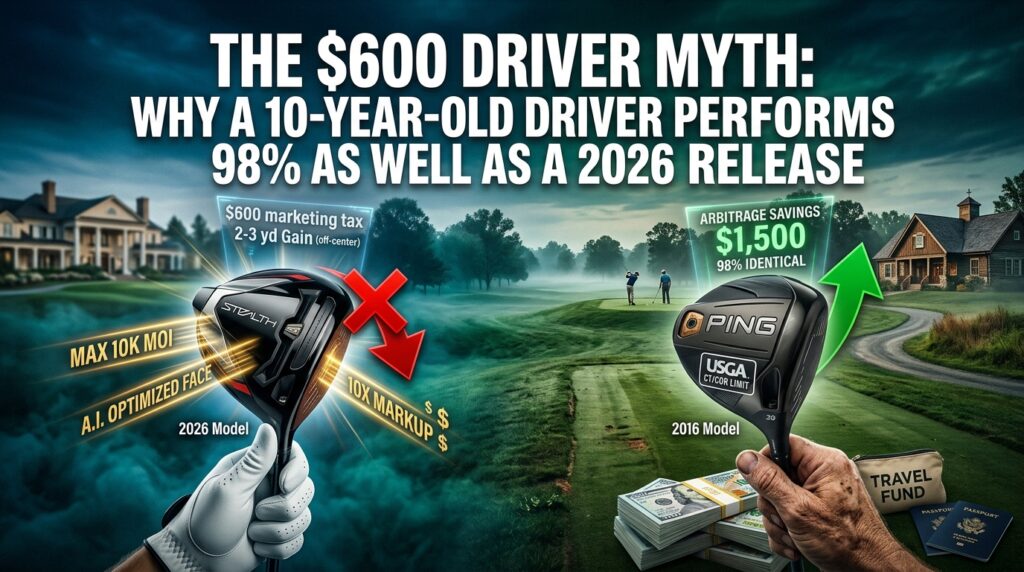
Every spring, the golf industry repeats the same tired ritual. A multi-million-dollar marketing blitz arrives on schedule, proclaiming that this year’s golf driver is a game-changing miracle. Equipped with AI-designed face geometries and 10K MOI stability, it promises to add 12 yards to your drives. It also claims to cure your slice overnight.
We buy into the hype and hand over six or seven hundred dollars at big-box retailers. We head to the range with our golf driver, expecting fireworks. But three weeks later, reality sets in: we’re still hitting the exact same 230-yard fade into the right trees.
Welcome to The $600 Driver Myth. It’s time to look at the engineering data, expose the regulatory limits enforced by governing bodies, and understand why holding onto a classic, well-fitted clubhead is the ultimate move in golf equipment arbitrage.
The Physics Wall: The USGA Stopped Raw Distance Gains Decades Ago
Here is the dirty secret the golf industry will never print on a display board: The maximum speed a driver face can legally transfer to a golf ball was capped over two decades ago.
In the late 1990s and early 2000s, driver technology experienced a genuine quantum leap as club makers shifted from persimmon and steel to thin-walled titanium. To stop distance from rendering classic courses obsolete, the USGA and R&A stepped in:
- The COR Limit (2000–2004): Sanctioning bodies set a hard limit on the Coefficient of Restitution (COR) at 0.830. This dictated that a clubface could not transfer more than 83% of its energy back into the ball on impact.
- The CT Limit Standard (2004–Present): To make testing portable at events, governing bodies adopted Characteristic Time (CT) testing. Using a pendulum device, they measure how many microseconds a pendulum weight stays in contact with the clubface. The absolute legal ceiling was capped at 239 microseconds (with an 18-microsecond measurement tolerance).
[1990s - Early 2000s] ──> Titanium Revolution ──> Massive Distance Explosions
[2004 - Present]     ──> USGA CT/COR Ceiling  ──> Legal Speed Capped at 239µs
A maxed-out, conforming driver face built in 2016 hits the exact same legal speed limit as a 2026 flagship model off the assembly line.
What actually changes year-to-year isn’t raw, ball-exploding velocity on center strikes; it’s carbon crown placement, matte paint finishes, weight tracks, and aggressive marketing buzzwords designed to justify a $600 price tag.
Off-Center Forgiveness vs. The Reality of Human Swings
OEMs will counter this by arguing, “We aren’t promising more distance on center hits; we’re giving you maximum forgiveness on off-center strikes!”
While modern drivers do use carbon fiber composites to push weight to the extreme perimeter (increasing Moment of Inertia, or MOI), the practical benefits for amateur golfers are vastly exaggerated:
- The Speed Falloff: On a shot struck 3/4 of an inch off-center, a 2026 driver might preserve 1 to 2 mph more ball speed than a driver from 2017. At an average amateur swing speed of 92 mph, that translates to roughly 2 to 3 yards of saved carry distance.
- Side Spin Still Kills You: Higher MOI stops the clubhead from twisting as much on a toe or heel strike, but it cannot override basic swing mechanics. If your clubface is open 6 degrees to an outside-in swing path, no amount of perimeter weighting will stop that ball from slicing 35 yards off the fairway.
Paying $600 to buy back 3 yards on a mishit while still landing in the native area is a terrible financial trade.
The Math of the $600 Marketing Tax
Let’s look at the financial reality of upgrading a golf driver every two years versus playing a classic, high-performing head (like a Ping G400, Cobra F9, or TaylorMade M2) paired with a properly fit shaft:
| Strategy | Equipment Strategy | 6-Year Equipment Dues | On-Course Performance Difference |
| The Annual OEM Upgrader | Buys new $600–$700 flagship drivers every 2 years | $1,800 – $2,100 | Marginally tighter dispersion (+2 to 4 yards on mis-hits) |
| The Arbitrage Golfer | Keeps/buys a classic high-MOI head ($150) + custom shaft fit ($200) | $350 | Optimized launch angle, ideal spin rates, maximum distance |
| Your Arbitrage Capital | Money Redirected to Real Golf | +$1,450 to +$1,750 | Funds 3+ Bucket-List Golf Trips |
The True Upgrade: Invest in the Shaft, Not the Badge
Instead of handing $600 to an OEM marketing department, a smart player uses Golf Arbitrage:
- Keep or Buy a Proven Classic Head: Grab a clean, 5-to-8-year-old high-MOI driver head off the secondary market for $120 to $180.
- Book an Independent Shaft Fitting: Spend $100 to $200 on an unbiased fitting to find the exact shaft weight, flex profile, and kick-point that matches your tempo and release.
A properly fit shaft lowers your dispersion, optimizes your launch angle, and controls spin rate—delivering real, visible improvements on the course that no off-the-shelf $600 stock driver can match.
Reclaiming Your Capital for the Game
That $1,500+ you save over a few seasons by ignoring the annual driver release cycle isn’t just a number on a balance sheet. It’s functional capital that can be deployed into real experiences:
- It pays for a full week-long road trip to public golf meccas like Bethpage Black or Torrey Pines.
- It easily covers flights, luxury accommodations, and greens fees in world-class value destinations like Clark, Philippines or Almaty, Kazakhstan.
Stop falling for the $600 golf driver illusion. Play the classic head. Fit the shaft to your actual swing, and use the savings to play the best public tracks on Earth.