
The 3-Wood Trap: The Free Adjustable Hosel Trick That Tames Your Hardest Club
It is widely considered one of the absolute scariest shots in golf: you are standing in the middle of a perfect fairway on a long par-5, you have about 220 yards left to the green, and you pull your 3-wood out of the bag.
You take a mighty swing off the turf, only to watch the ball violently top across the grass, lift a mere three feet off the ground, or slice weakly into the right-hand rough.
If this sounds familiar, don’t rush to book a $100 swing lesson or throw your club into the nearest lake. The truth is, hitting a standard 3-wood directly off the grass (“off the deck”) is one of the hardest skills in the entire sport. The physics of the club are actively stacked against you.
The good news? If you own a modern fairway wood, the solution to this scorecard-ruining nightmare is already sitting in your bag—and it won’t cost you a single dime.
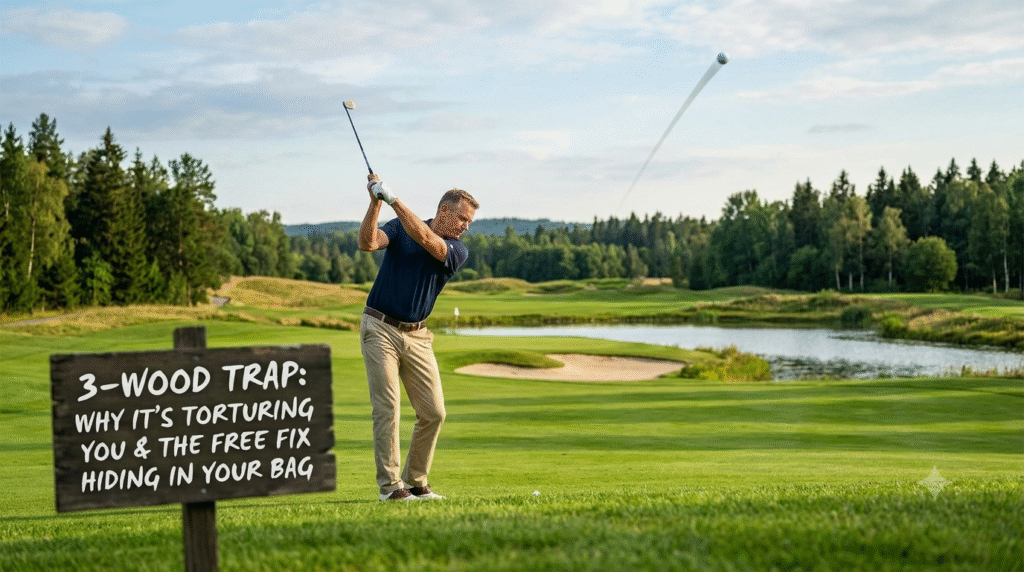
Why the Traditional 3-Wood is an Amateur Trap
To understand why your 3-wood feels like a heavy butter knife on the fairway, we have to look at the two numbers that dictate its performance: Loft and Shaft Length.
[Standard 3-Wood Profile]
 ├── Loft: 15° (Extremely flat; requires Tour-level speed to launch)
 └── Shaft: ~43 inches (Long; makes center-face contact highly difficult)
A standard 3-wood features roughly $15^\circ$ of loft. To launch a ball into the air from a tight, flat lie on the grass with only $15^\circ$ of lift, you need a massive amount of clubhead speed (usually 95+ MPH). When PGA Tour pros hit a 3-wood, their immense speed creates enough backspin to force the ball upward into a high, majestic arc.
However, the average amateur golfer swings significantly slower. Without that elite speed, a $15^\circ$ club cannot create enough lift. The result? The ball falls out of the sky prematurely, or you subconsciously try to “scoop” the ball into the air, leading to a catastrophic top or chunk.
Without elite speed, a $15^\circ$ club simply cannot create enough aerodynamic lift. The result? The ball falls out of the sky prematurely, or you subconsciously try to “scoop” the ball into the air, leading to a catastrophic top or chunk. Much like playing stubborn, low-bounce wedges on plush turf—a concept we broke down in The Wedge Bounce Blueprint—using a club with the wrong physical specifications forces you to make bad compensations in your swing.
Compounding the issue is the shaft length. The 3-wood has the second-longest shaft in your bag. The longer the shaft, the harder it is to consistently hit the dead center of the clubface.
The Free Fix: The Adjustable Hosel Trick
If your 3-wood has a small screw on the bottom of the clubhead where it connects to the shaft, you possess an adjustable hosel sleeve. It’s time to dig that adjustment wrench out of your golf bag pocket.
Instead of fighting the laws of physics, we are going to change the club’s architecture.
[Unscrew Head] ──> [Rotate Sleeve to +1.5° or +2.0°] ──> [Tighten Click Wrench]
                               │
                       [The Resulting Transformation]
                 15° Stubborn 3-Wood  👉  17° Forgiving "4-Wood"
How to do it:
- Use your torque wrench to unscrew the clubhead completely.
- Rotate the adjustable adapter sleeve to the setting marked +1.5 deg or +2.0 deg (or the setting marked “HIGHER”). For an exact breakdown of your specific brand’s sleeve markings, you can consult the GolfWorks Loft & Lie Adjustment Guide.
- Slide the clubhead back on and tighten it until the wrench clicks.
Why this instantly fixes your shot:
By lofting your club up, you have officially transformed a stubborn, low-launching 15 deg-wood into a highly forgiving $16.5 deg or $17 deg “4-wood.”
That extra degree and a half of loft completely changes the physics of the strike. It instantly increases your launch angle and introduces a helpful baseline of backspin. Even though reducing the club’s “paper loft” seems like it would reduce your distance, your real-world distance will actually increase because the ball will stay airborne far longer rather than dropping straight into the turf.
As a bonus, lofting a club up slightly closes the clubface angle, which helps neutralize that weak, leaking slice that plagues most fairway wood shots.
The Choke-Down Precision Hack
Now that your clubhead is optimized with more loft, it’s time to tackle the long shaft.
On the fairway, do not grip the club at the absolute end of the rubber handle. Instead, choke down between a half-inch to a full inch on the grip.
[Standard Grip] ──❌ Too Long / Hard to Control Off Grass
[Choked Down 1"] ──✅ Shortens Arc / Maximizes Center-Face Strikes
Shortening your grip does two highly beneficial things:
- It brings your hands closer to the ball, drastically increasing your control and ability to hit the dead center of the clubface.
- It flattens your swing plane slightly, preventing the club from digging too steeply into the dirt.
A center-face strike with a choked-down, $17 deg “4-wood” configuration will fly straighter, higher, and further than a badly mis-hit swing with a full-length, low-lofted $15 deg club every single day of the week. Best of all, modifying the club you already own leaves your equipment budget completely intact, allowing you to save that cash for an bucket-list golf trek like the one in our Almaty, Kazakhstan Travel Guide.
Swallow Your Pride, Save Your Scorecard
Golf equipment companies sell 3-woods because “3-Wood” is what players expect to see in a standard set layout. But the world’s best club fitters will tell you that unless you have elite swing speed, a standard 15-degree fairway wood off the grass is a losing proposition.
Stop trying to force a club configuration built for the PGA Tour into your weekend rounds. Pull out your adjustment wrench, lift that loft up, choke down on the handle, and watch your terrifying par-5 approach shots transform into high, smooth, stress-free launches.