
The Bounce Blueprint: Stop Buying Wedges by Loft Alone (And Save Your Short Game)
Walk into any big-box golf retail store, and you’ll see players choosing their wedges based entirely on one single number: the loft. They look for a 56-degree or a 60-degree club, check the brand name, and head straight to the register.
If you are doing this, you are actively sabotaging your short game.
The most critical factor in whether you hit a crisp, spinning chip shot or chunk the ball three feet into a mud puddle isn’t the loft. It’s the smaller, heavily ignored number stamped right next to it: the bounce angle. Bounce is your ultimate insurance policy around the greens, acting as a “skid plate” that dictates how your club interacts with the earth.
And if you are traveling to play golf, or living in a climate with volatile weather patterns like Southeast Asia, matching your wedge’s bounce to the shifting seasonal turf is the ultimate cheat code to lower scores.
What is Wedge Bounce? (The 60-Second Breakdown)
Wedge bounce is the angle created between the leading edge of your clubface and the lowest point of the sole (the trailing edge).
Bounce Angle = The angle the sole makes with the ground at address
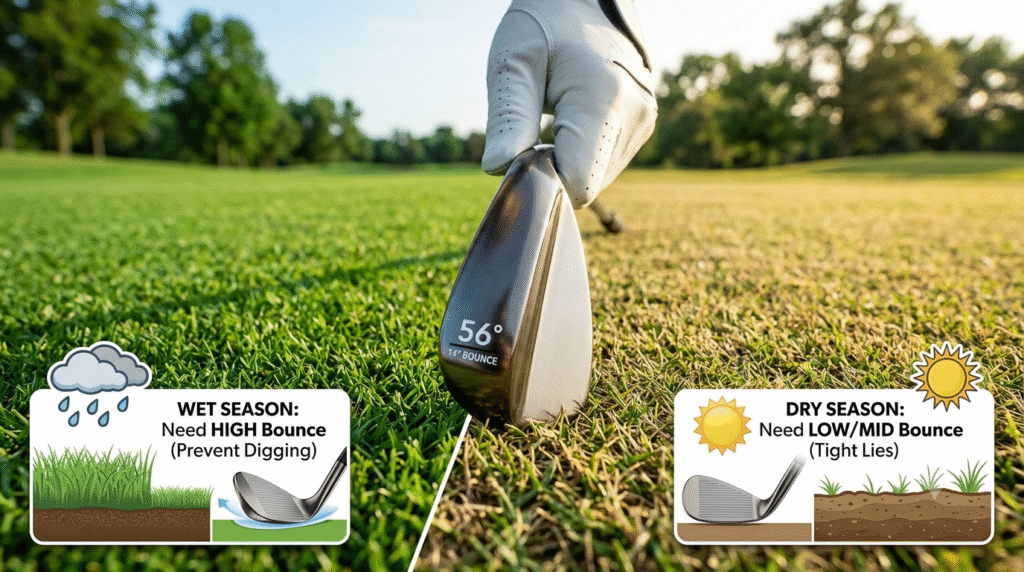
- High Bounce (12 deg – 14 deg): Features a fatter, more angled sole. It prevents the club from digging into the ground, causing the wedge to glide smoothly through the turf.
- Low Bounce (4 deg – 7 deg): Features a thin, sharp sole. It allows the leading edge to sit completely flush with the ground, making it easy to slip the face under the ball on tight lies.
If you use a low-bounce wedge on soft, fluffy grass, the sharp edge acts like a knife, digging straight into the dirt and creating a massive, ugly chunk. Conversely, if you use a high-bounce wedge on rock-hard, sun-baked dirt, the fat sole will literally bounce off the ground, causing you to skull the ball directly into the next county.
The Monsoonal Shift: The Southeast Asian Turf Puzzle
This turf-to-bounce dynamic becomes hyper-amplified when you play in tropical climates like Thailand, Malaysia, Indonesia, Vietnam, or the Philippines. Unlike Western golf courses covered in fine bentgrass, Southeast Asia is dominated by coarse, warm-season grasses like Zoysia (Manilagrass) and Bermudagrass.
These grasses grow thick, sideways blades that create an aggressive, sticky “grain.” Furthermore, these regions don’t stay the same year-round; they alternate aggressively between two distinct seasons, requiring a strategic bag setup:
1. The Wet Season (The Monsoon Soak)
During the heavy tropical rainy seasons, the ground beneath the dense Zoysia mattress becomes incredibly soft, muddy, and saturated.
- The Danger: A low-bounce wedge will instantly snag on the sticky grass grain and bury itself deep into the soft tropical mud.
- The Solution: High Bounce (12 deg – 14 deg). You need a fat sole that acts like a surfboard, providing the necessary “floatation” to slide across the wet mud and pop the ball cleanly into the air.
2. The Dry Season (The Sun-Baked Hardpan)
When the monsoon rains clear and the intense tropical sun beats down for months, public courses dry out completely. The fairways turn firm, fast, and sparse, creating tight, unforgiving “hardpan” lies.
- The Danger: If you try to open up a high-bounce wedge on a baked, bare lie, the sole will strike the hard earth first and skull the ball across the green.
- The Solution: Low-to-Mid Bounce (6 deg – 10 deg) with Heel/Toe Relief. You need a club that can sit tight to the ground so you can slide the leading edge under the ball without the sole interfering.
The Budget “Mixed-Matrix” Bag Strategy
You don’t need to buy two entirely separate sets of wedges for different seasons—that completely defies our core philosophy at The Budget Golfer, just like we outlined in our Under-S$700 “Franken-Bag” Layout. Instead, you build a versatile, mixed-bounce matrix using a blend of lofts.
By strategically gapping your bounce numbers, you possess a survival tool for both the wet mud and the dry hardpan in your bag at all times:
    [Your Pitching Wedge]
             │
             ▼
    [52° Gap Wedge]   -->  Mid Bounce (10°)   [The All-Rounder]
             │
             ▼
    [56° Sand Wedge]  -->  High Bounce (14°)  [Wet Mud / Fluffy Bunkers]
             │
             ▼
    [60° Lob Wedge]   -->  Low Bounce (8°)    [Dry Hardpan / Tight Lies]
- The 56-Degree Workhorse (High Bounce – 14 deg): This is your ultimate weapon for the wet season, heavy rough, and soft, tropical bunkers.
- The 60-Degree Specialist (Low-to-Mid Bounce – 8 deg): Keep this low-to-mid bounce with an “M” or “C” sole grind (where metal is shaved off the heel and toe). This allows you to open the clubface wide on sun-baked, dry-season tight lies without raising the leading edge off the ground.
How to Shop for Bounce on a Budget
Wedge faces wear out over time because of sand and friction, but you don’t need to drop $180+ on the newest premium releases to get spin control.
Instead of buying a brand-new matching trio, head to the pre-owned market. Manufacturers like Titleist (Vokey), Cleveland, and Callaway stamp their bounce numbers and grind letters directly onto the clubheads. Look for deals on previous-generation models like the Titleist Vokey SM8/SM9 or Cleveland RTX ZipCore.
As long as the grooves feel sharp to your thumbnail, buying a used $60 wedge with the correct bounce for your local turf will save your scorecard infinitely faster than a brand-new $180 wedge with the wrong bounce.
Stop playing a guessing game around the greens. Check the numbers on your soles, match them to your local climate, and start turning those miserable chunks into tap-in pars.